
Phosphating
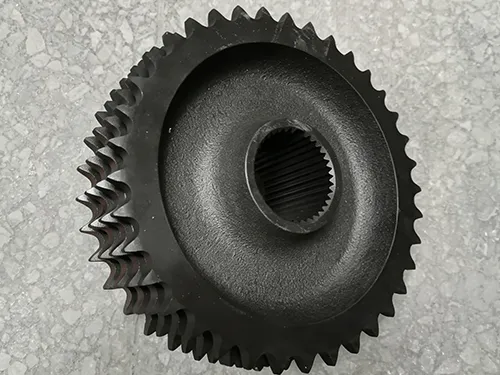 Phosphate-Coated Sprocket
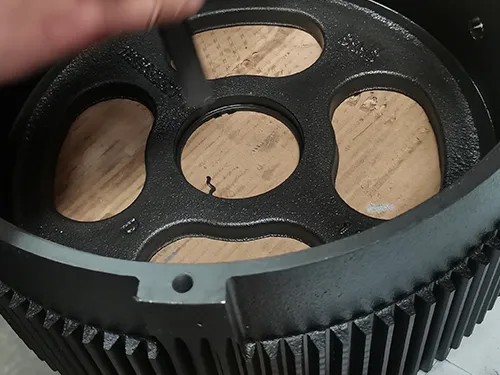 Phosphate-Coated Gear
Phosphating involves immersing steel or metal parts in an acidic phosphate solution, forming a water-insoluble, porous phosphate conversion coating on the surface through a chemical reaction. This coating improves paint adhesion, provides short-term rust prevention, and enhances lubrication during subsequent forming operations. This is suitable for carbon steel, low-alloy steel and cast iron. Coating thickness is 1 μm to 5 μm for paint pretreatment, and 5 μm to 15 μm for rust prevention. The finish is uniform and smooth, free from powdery residue or rust spots.
Degreasing & Rust Removal → Water Rinsing → Phosphating → Water Rinsing → Post-Phosphating Treatment
- Higher processing temperatures produce thicker phosphate coatings with larger crystal structures, while lower temperatures produce a thinner layer with finer crystals.
- Post-treatment improves the corrosion resistance and rust prevention of the coating. Common options include powder coating, spray painting, electrophoretic coating, and applying anti-rust oil, etc.
- Low cost and a well-established process, using simple equipment that is suited for high-volume production.
- Minimal dimensional change, as the film is only 1 μm to 15 μm thick, making it suitable for precision parts.
- Provides uniform coverage on complex shapes, including welds, blind spots and inside holes.
- The phosphate coating consists of countless microscopic porous crystals that allow paint to penetrate and anchor to the surface, significantly improving coating adhesion.
We provide phosphating treatment for metal components to improve surface protection and enhance corrosion resistance.
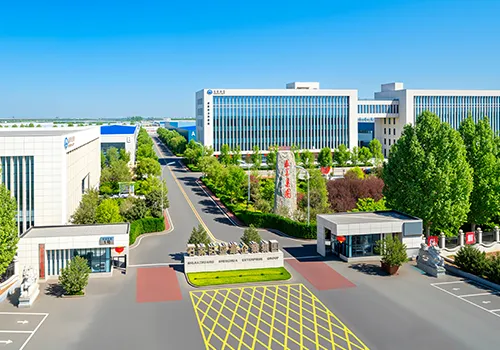
- More than 30 years of manufacturing and export experience, with extensive knowledge of international logistics and industry-specific technical standards.
- Full support from tooling design and sample development through to high-volume production, precision machining, and surface treatment.
- A strict ISO 9001 quality management system, backed by CMM (coordinate measuring machine) inspection and non-destructive testing (MT, RT, PT).